 how-to
How Do You Schedule an Office Cleaning Service?
Last Updated: October 25, 2026
Quick Summary
To schedule office cleaning, build a written checklist that assigns each task a frequency, then set your service cadence from peak occupancy and foot traffic rather than a generic package. Confirm access details in writing and book the first visit as a walkthrough before starting recurring service.
- Daily tasks cover high-touch surfaces, restroom wipe-downs, waste removal, and spot vacuuming.
- Plan one restroom service pass per roughly 25 to 30 peak occupants per day.
- Review cleaning schedules at least twice a year and adjust as occupancy changes.
- Schedule the first clean as a walkthrough, not a full service.
- Bring space size, occupancy numbers, must-clean list, and access details to your consultation.
Table of Contents
- Why a Written Office Cleaning Schedule Beats Guesswork
- Building Your Office Cleaning Checklist by Task and Frequency
- How to Choose Commercial Cleaning Frequency for Your Space
- Weekly vs. Biweekly Office Cleaning: Which Fits Your Workplace?
- After-Hours Office Cleaning: Access, Keys, and Avoiding Disruption
- Assigning Cleaning Responsibilities and Setting Quality Checks
- What to Bring to Your First Cleaning Consultation
- Frequently Asked Questions
Why a Written Office Cleaning Schedule Beats Guesswork
The U.S. janitorial services industry is worth an estimated $112.4 billion in 2026, according to IBISWorld's janitorial services industry analysis. That number tells you something useful: cleaning is a real line item, not an afterthought. Yet plenty of offices still run on a vague "someone comes Tuesdays" arrangement. When you schedule office cleaning service properly, you replace that guesswork with a written plan that names tasks, owners, and timing. A written schedule fixes that fast. It also gives you something to hold a provider to. Below, we'll show you exactly how to build one, from task lists to frequency math to after-hours access.
Building Your Office Cleaning Checklist by Task and Frequency
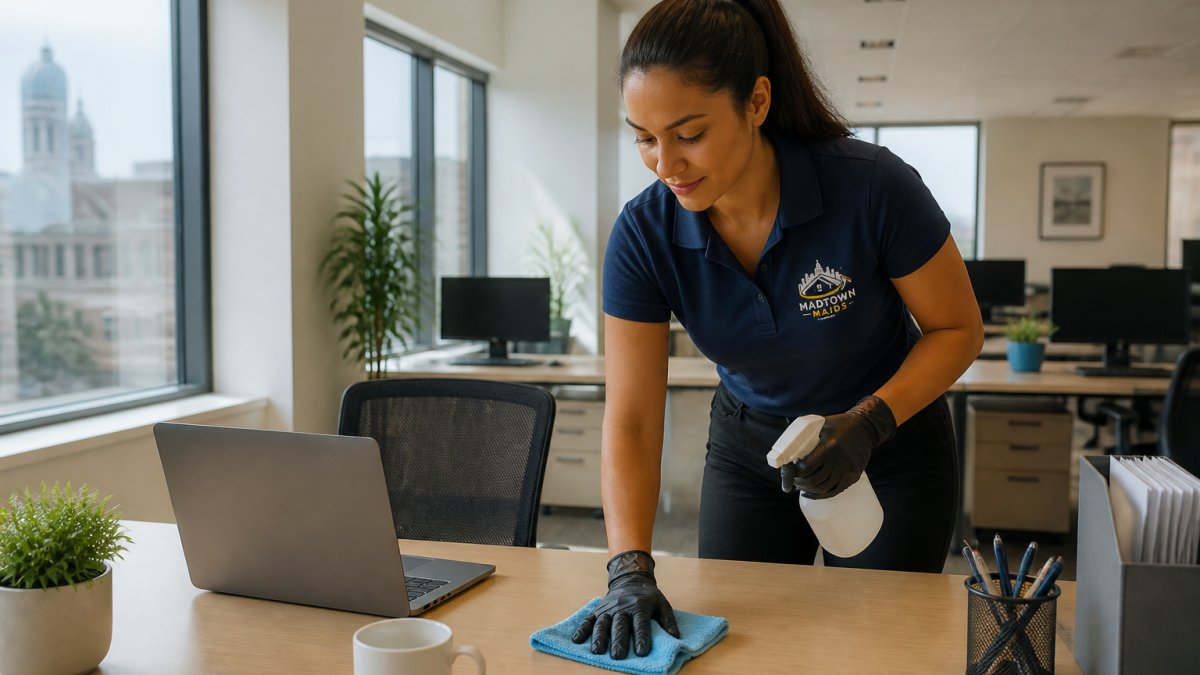
An office cleaning checklist is a written list of every task, who does it, and how often. Start with the tasks you can see: desks, floors, restrooms, the break room. Then assign a frequency to each one. A JAN-PRO office cleaning checklist estimates a small-office routine takes 15 to 30 minutes. Bigger spaces need dedicated staff or a structured plan. If you want a ready-made example to model your own list on, a cleaning checklist can show a room-by-room breakdown.
Daily, Weekly, and Monthly Task Groups
- Daily: high-touch surfaces, restroom wipe-downs, waste removal, spot vacuuming
- Weekly: full vacuuming, mopping, dusting, break room and kitchen cleaning
- Monthly: baseboards, vents, interior windows, deeper disinfection
Quarterly and Periodic Deep Cleaning
Deep cleaning covers what routine work skips: carpets, upholstery, light fixtures, and floor care. Schedule it quarterly or twice a year. Green Seal's GS-42 standard says cleaning schedules should be reviewed at least twice a year and adjusted as needed. That review is where deep cleaning earns its place.
How to Choose Commercial Cleaning Frequency for Your Space
Commercial cleaning frequency is how often your space gets serviced, and it should fall out of your occupancy, foot traffic, and business hours, not a generic package tier. A 5-person office with remote staff needs less than a 50-person call center. A 2026 facility-management trends report recommends flexible schedules that reflect real occupancy trends. The problem is that most frequency advice stops at "weekly or biweekly" without showing you how to get there. Here is a decision framework to consider when scoping a new office.
Calculating Frequency from Occupancy and Foot Traffic
Start with three inputs you can measure this week:
- Peak occupants per day. Count the most people who are in the building at the same time, not total headcount. A 60-person company with a 40% remote rate may only peak at 36.
- High-traffic zones. Lobby, restrooms, break room, and any shared conference rooms. These drive frequency more than desk count does.
- Business hours and visitor load. A client-facing office with daily walk-ins needs more frequent restroom and lobby service than a back-office suite with badge-only entry.
Then apply a simple load rule. Restrooms are the binding constraint in most offices: plan one service pass per roughly 25 to 30 peak occupants per day, and add a midweek touch-up once you cross about 30. Floors follow foot traffic, vacuum high-traffic paths weekly at low occupancy and daily once you pass roughly 50 peak occupants. Break rooms and kitchens generally need daily attention once more than about 15 people use them, because food waste and shared appliances degrade faster than desk areas.
| Peak occupants/day | Restrooms | Floors | Break room | Recommended frequency |
|---|---|---|---|---|
| Under 10 | 2-3x weekly | Weekly | Weekly | Weekly or biweekly |
| 10-30 | Daily | 2x weekly | Daily | Weekly plus midweek touch-up |
| 30-75 | Daily | Daily | Daily | 2-3x weekly |
| 75+ | 2x daily | Daily | Daily | Daily |
Treat the table as a starting point, not a verdict. If your restrooms see daily use from visitors, move up a row even if headcount says otherwise.
Adjusting Frequency for Business Hours and Seasonality
Business hours change the math. An office that runs two shifts, or that hosts evening events, effectively doubles its occupied hours and should be scheduled against the busiest shift, not the average. Seasonal swings matter too: winter flu season, tax-season crunch weeks, and end-of-quarter client visits are common reasons to add a temporary deep clean or a midweek touch-up without changing your base contract.
When to Move Up or Down a Frequency Tier
Review frequency at least twice a year, and sooner if you change headcount, add a shift, or notice recurring complaints about restrooms or break rooms. A common pattern is to start weekly, drop to biweekly after a hybrid schedule settles in, and add a quarterly deep clean to cover what routine visits skip. The goal is not the cheapest tier, it is the tier where your team stops noticing cleaning problems between visits.
Weekly vs. Biweekly Office Cleaning: Which Fits Your Workplace?
Weekly vs. biweekly office cleaning comes down to foot traffic and how much your team cleans between visits. Weekly service suits busy offices with shared restrooms and daily visitors. Biweekly fits small teams with light traffic and self-serve tidying. A commercial-cleaning provider argues that a tailored schedule keeps spaces hygienic without overcommitting resources, per ServiceMaster's cleaning schedule guide. Consider picking weekly if restrooms see daily use, or biweekly if your team already wipes desks.
After-Hours Office Cleaning: Access, Keys, and Avoiding Disruption
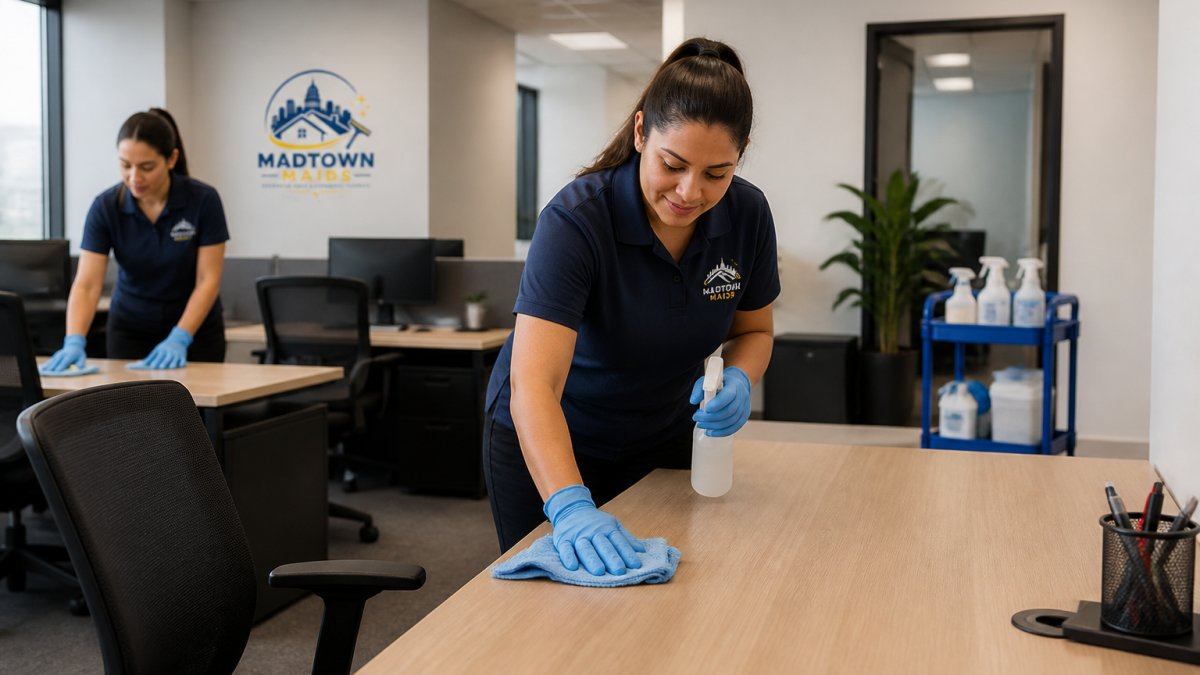
After-hours office cleaning keeps crews out of your workday, but the keyword is schedule, and most guides stop at "give them a key." The practical work is in the logistics: how access is granted, how the first visit is confirmed, and how you keep the service from disrupting the next morning. Here is the sequence that avoids the common failure points.
Access Setup: Keys, Codes, and Alarms
Confirm access before you sign, not the week of the first clean. Decide whether you will issue a key, a lockbox code, or a temporary access credential, and put it in writing who holds it and how it is returned. Share alarm codes and the disarm window, the minutes between entry and when the alarm must be disarmed, and name one contact who can answer a call during the service window. Unlabeled alarm codes and stale access lists are the most common cause of a missed first cleaning, so keep a single owner for access changes and update the provider in writing whenever a code or contact changes.
Booking Cadence and First-Visit Walkthrough
Schedule the first clean as a walkthrough, not a full service. Walk the space with the crew lead, point out restrooms, break room, supply closets, and any areas that are off-limits, and confirm the scope line by line against your checklist. Agree on the service window, for example, entry no earlier than 6 p.m. and exit by 10 p.m., and confirm how the crew will lock up and re-arm the alarm. After the walkthrough, set a recurring cadence in writing: which days, which window, and who to call if a visit needs to move. Before your first visit, consider how to prepare for cleaners so nothing gets missed.
Avoiding Disruption to the Next Workday
Disruption planning is where after-hours service earns or loses its value. Confirm where supplies are stored so nothing blocks aisles, how trash is staged for pickup, and whether floors need time to dry before the first morning arrival. If your team starts early, ask the provider to sequence restrooms and high-traffic paths first so they are dry and ready. Keep a shared log of issues, a supply that ran out, a room that was skipped, an alarm that tripped, and review it at the monthly check-in. That log is also your evidence if you need to adjust scope or frequency later.
Assigning Cleaning Responsibilities and Setting Quality Checks
Split duties clearly. Your team handles desks and personal items. The crew handles restrooms, floors, and shared spaces. Put that split in writing as your service scope. Then add quality checks: a short walkthrough after each visit, a photo log for problem areas, and a monthly review against your checklist. This is where a written schedule pays off. You stop arguing about whether a task happened and start pointing to a completed line item.
What to Bring to Your First Cleaning Consultation
Bring four things to your first consultation: your space size in square feet, your occupancy numbers, your must-clean list, and your access details. Add your budget range and preferred days. With those in hand, a provider can quote accurately instead of guessing. If you want to see how a flexible commercial plan works for offices, retail, and medical spaces, review commercial cleaning services. Ready to move? Get a free cleaning quote.
Frequently Asked Questions
How often should an office be professionally cleaned?
Most offices do well with professional cleaning two to three times per week, with daily attention to restrooms, break rooms, and high-touch surfaces handled by staff or a lighter daily service. Spaces with fewer than ten employees and low visitor traffic can often drop to weekly cleaning. High-traffic offices, medical suites, and shared coworking spaces usually need daily service. Green Seal's GS-42 standard recommends reviewing your cleaning schedule at least twice a year and adjusting it as occupancy and building needs change.
Should I choose weekly or biweekly office cleaning?
Weekly office cleaning suits workplaces with steady foot traffic, client visits, or shared kitchens where trash and spills build up fast. Biweekly cleaning works for smaller teams, low-occupancy suites, or offices where staff handle light daily tidying. If you are unsure, start weekly for a month and track how the space looks on day five and day ten. Many offices settle on weekly for common areas and biweekly for private offices.
Can cleaning happen after hours without disrupting our team?
Yes. After-hours office cleaning is standard for commercial providers and usually runs between 6 p.m. and 6 a.m., or on weekends. You will need to arrange access, which might mean a key, a lockbox, an alarm code, or a building access card for the crew. Confirm who holds the alarm code and how the team signs in and out. Ask for a written service window so your security and property manager know when crews arrive.
What should be included in an office cleaning schedule?
A workable schedule lists each task, how often it happens, who owns it, and when it was completed. At minimum, cover restrooms, break room and kitchen surfaces, waste and recycling removal, vacuuming and mopping, dusting, high-touch surface disinfection, and periodic deep cleaning like carpet care and window washing. Add a scope of work and a quality check step so you can confirm the job was done to standard, not just that someone showed up.
Scheduling office cleaning service shouldn't feel like a gamble. Madtown Maids offers trained, background-checked teams, flexible evening and weekend scheduling, and no long-term contracts, all with transparent pricing. Get started with Madtown Maids and build a cleaning schedule your office can actually rely on.